COLUMBUS DAY
COLUMBUS DAY
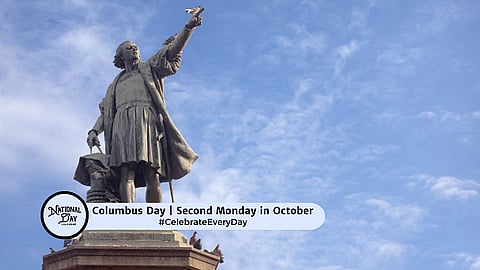
Columbus Day is a federal holiday in the United States observed on the second Monday of October. The day commemorates the arrival of Christopher Columbus in the Americas on October 12, 1492. While historically celebrated as the "discovery" of the Americas, the holiday's modern observance is complex and often subject to debate.
#ColumbusDay
Christopher Columbus (1451–1506) was an Italian-born explorer sailing for the Spanish Crown. His objective was to find a westward sea route to Asia. On August 3, 1492, Columbus departed from Spain with three ships: the Niña, the Pinta, and the Santa María. On October 12, 1492, the expedition made landfall on an island in the present-day Bahamas. Columbus would make a total of four voyages across the Atlantic to the Americas.
It is a historical fact that Columbus was not the first European to reach the Americas. Norse explorer Leif Erikson is credited with landing in North America around 1000 A.D., nearly 500 years before Columbus's first voyage. Furthermore, the continents were already inhabited by millions of Indigenous people.
Columbus's voyages initiated a period of sustained contact between the Eastern and Western Hemispheres, an era known as the Columbian Exchange. This exchange led to the widespread transfer of plants, animals, technology, and ideas. However, these voyages also marked the beginning of European colonization, the transatlantic slave trade, and the decimation of Indigenous populations through newly introduced diseases, warfare, and enslavement.
In recent decades, the celebration of Columbus Day has become increasingly controversial. Critics argue that honoring Columbus overlooks the devastating impact his arrival had on Indigenous peoples. As a result, a growing movement has sought to replace Columbus Day with Indigenous Peoples' Day, a holiday that celebrates the history and cultures of the native peoples of the Americas. Many states, cities, and school districts across the country have formally adopted this change, choosing to observe Indigenous Peoples' Day in place of, or in addition to, Columbus Day.
HOW TO OBSERVE COLUMBUS DAY
Learn more about Christopher Columbus and his voyages. Use #ColumbusDay to post on social media.
COLUMBUS DAY HISTORY
Observances of Columbus's voyage in the United States date back to the colonial period. Here is a quick overview of Columbus Day history.
1792: New York City and other U.S. cities held celebrations marking the 300th anniversary of his arrival.
1892: For the 400th anniversary, President Benjamin Harrison issued a proclamation calling on the people of the United States to celebrate. The event was used by community leaders to teach ideals of patriotism and citizenship.
1906: Colorado became the first state to declare Columbus Day an official state holiday.
1937: Columbus Day was established as a federal holiday in the United States.
1970: The date of the federal observance was officially changed to the second Monday in October.
DATES:
13 October 2025
12 October 2026
11 October 2027
9 October 2028
8 October 2029