EMERGENCY MEDICAL SERVICES FOR CHILDREN DAY
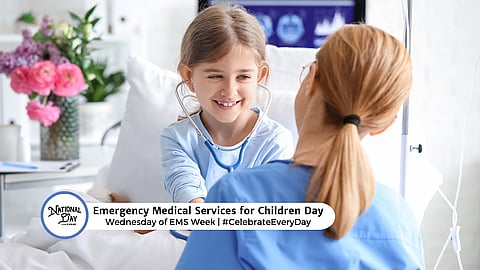
EMERGENCY MEDICAL SERVICES FOR CHILDREN DAY
We celebrate Emergency Medical Services for Children Day on Wednesday during Emergency Medical Services (EMS) Week. Also known as EMS Day, we give special thanks to EMS providers for the way they respond to the needs of millions of Americans every year.
#EMSForChildrenDay
On Emergency Medical Services for Children Day, we raise awareness of the need improving specialized care for children. Emergency care often comes from parents, caregivers, trained EMS providers and hospital personnel. Together, they strive to meet the unique needs of critically ill or injured pediatric patients.
Emergency Medical Services are a combination of resources that make up a large system. The organizational structure of EMS not only provides medical services, it also provides financial and community services. Agencies in EMS services include fire departments, law enforcement, search and rescue and medical personnel. In its entirety, EMS services is massive.
The primary goal of any EMS service is to provide emergency medical care. All EMS service are members of a community that are first on scene of an emergency and can identify health problems. Whether an emergency includes a accident, hazard spills or a life threatening illness, EMS service providers are trained individuals who have one goal--provide emergency medical care.
The network of EMS consists of, but are not limited to:
Private and public agencies.
Hospitals and trauma centers.
Rehab facilities.
Trained professionals for emergency treatment.
911 networks.
Volunteers.
Federal, state, city and county government officials.
10 WAYS HOW TO SUPPORT EMS FOR CHILDREN DAY
Support EMS personnel and first responders
Help bring quality EMS services to children and the entire community.
Participate in some of the hundreds of activities on EMS for Children Day and throughout the week.
Attend a training, in person or online, on EMS training.
Read fact sheets and fliers regarding EMS services.
Visit an EMS facility.
Update your knowledge on assisting in an emergency situations.
Take a First Aid course.
Advocate and support EMSC program in your area.
Use #EMSForChildrenDay to post on social media.
HISTORICAL MOMENTS FOR EMS
1967: The establishment of Division of Emergency Treatment & Transfer begins as a result to a growing concern highway crashes as dedication to EMS.
1969: Dr. William Haddon, former Director of the NHSB, introduces the first DOT Inter-Departmental Safety Seminar. Also known as the Haddon Matrix, the Matrix was the first groundbreaking model for EMS services.
1971: The National Standard Curriculum for EMTs becomes available as a national curriculum for EMTs. The curriculum sets the first national standards for the education of EMS professionals.
1974: President Gerald Ford declares November 3-10, 1974 as the first “National Emergency Medical Services Week.”
1984: Health Resources and Services Administration (HRSA) funds the new EMS for Children program.
1996: A community effort to guide the development of EMS systems appears.
2001: Establishment of the National EMS Information System, or NEMSIS, reaches local, regional and state levels. The new system will lay foundation for better data collection regarding EMS services and training.
2005: The National 911 Program is born, providing a reliable and cost-effective system taking advantage of new communications technologies.
2007-2013: Assessments, technology, recommendations and funding improve the EMS service system.
2019: Nearly two decades after the original EMS Agenda for the Future was published, hundreds of stakeholders from the EMS community create a new innovative vision for the EMS system.
National EMSC Day was founded by the federal EMSC Program and partners with the American College of Emergency Physicians, the American Academy of Pediatrics and the Emergency Nurses Association to raise awareness concerning the need for improved care for children in prehospital and acute care settings.