NATIONAL BROWN-BAG-IT DAY
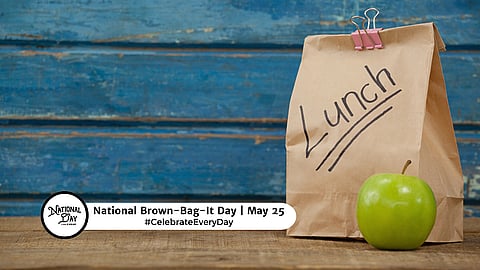
NATIONAL BROWN-BAG-IT DAY
National Brown-Bag-It-Day on May 25 each year recognizes the benefits of packing your lunch for work or school.
#BrownBagItDay
Taking your lunch to work or school is an effective way to save money and to ensure you and your family are eating healthy. Brown-bagging-it allows you to make better choices and save money. For every meal you make at home, you can save several dollars a day. This is especially true if you are normally prone to eating out, ordering in from restaurants or eating out of vending machines at work. If you're time is short supply during the day, taking your lunch to work helps you limit your choice to have something unhealthy. Even though we try to control our portions while eating out, we know the serving size just keep getting bigger and bigger. When we brown-bag-it, we maintain that control.
Paper bags are 100% biodegradable, reusable, and recyclable, making them better for the environment. When we reuse the same containers and recycle, we have more control over what is wasted. We also choose where our food is sourced. Besides, paper bags can withstand more pressure or weight than plastic bags.
Paper Bag Logistics
To the average person, a paper bag is just a bag. But, making paper bags is a serious business. In fact, a paper bag has special sections that make it functionable to use. Here are some common paper bag terms you may (or may not) care to know:
Paper basis weight: The thickness of the paper to construct a bag determines the basis weight increase. When the amount of paper increases, the basis weight increases. Paper bags with a basis weight of 30-49 lbs. is standard duty, and 50 lbs. or more mark heavy duty.
Gusset: The folded part at the bottom of the paper bag that expands when opening.
Flat Bottom Paper Bags: The most common type of paper bag.
Pinch Bottom Paper Bags: Have an attached bottom that is sealed across, mostly used for candy and greeting cards.
HOW TO OBSERVE BROWN-BAG-IT DAY
Pack up your lunch in a brown paper bag.
Pick your favorite foods and enjoy a homemade lunch.
Make a puppet.
Use #BrownBagItDay to post on social media.
A BAG OF HISTORICAL FACTS
1852: Schoolteacher Francis Wolle invents the first machine to mass produce paper bags. Following the invention, they would open the Union Paper Bag Company.
1853: Papermaker James Baldwin, Birmingham and Kings Norton, England, is granted a patent to make square-bottomed paper bags. His apparatus would contain an an image of a bag with a flat bottom with his business logo in view.
1871: Inventor Margaret E. Knight designs the first machine to create another paper bag with more room for carrying things.
1883: Charles Stilwell patents his own machine that makes square-bottom paper bags with pleated sides, known as the S.O.S., "Self-Opening Sack." His design advancements make paper bags easier to store.
1912: St. Paul, Minnesota, grocer Walter Deubener adds a cord to paper bags and reinforces the sturdiness and portability of paper bags. The Deubener Shopping Bags sell over a million bags by 1915. Eventually, Walter's paper bag invention would become the standard style of paper bags stores would use.
1970s: Unfortunately, with the introduction of plastic bags, paper bags would begin to fade. However, some places would continue to offer paper bags for some time.
2015: The EU would adopt directive (EU) 2015/720 requiring the reduction of use of plastic.
2018: “European Paper Bag Day” begins on behalf of kraft paper manufacturers and producers of paper bags to raise awareness on sustainable packaging solutions.
2019: Adoption of Directive (EU) 2019/904 by the European Parliament and of the Council in June to reduce the impact of plastic products have on the environment.