NATIONAL KENTUCKY DAY
NATIONAL KENTUCKY DAY
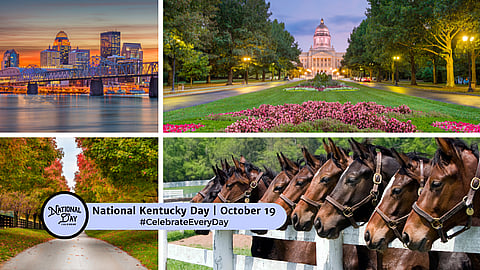
On October 19, we celebrate National Kentucky Day, a tribute to the 15th state to join the union and a land of spirited traditions, breathtaking landscapes, and unforgettable flavors. From the thundering hooves at Churchill Downs to the soulful strum of a banjo in the Appalachian hills, Kentucky offers an experience that captivates the senses and stays with you long after you've left.
#NationalKentuckyDay
You can't talk about Kentucky without talking about its world-famous food and drink. This is the heart of bourbon country, where historic distilleries along the legendary Kentucky Bourbon Trail® craft America's native spirit. But the culinary journey doesn't stop there. Dive into iconic dishes like the hot brown, a rich, open-faced turkey sandwich smothered in Mornay sauce or the Hearty Burgoo, a thick, savory stew that's a staple at community gatherings and barbecues. Finish any meal with the Derby-Pie®, a decadent chocolate and walnut tart that is a sweet slice of tradition.
Beyond the rolling bluegrass hills of horse country, Kentucky's natural beauty is the stuff of legend. Daniel Boone once blazed trails through this wild frontier, and today, those paths lead to incredible adventures. Descend into the Mammoth Cave National Park, the world's longest known cave system, for a subterranean adventure unlike any other. Stand in awe of Cumberland Falls, known as the "Niagara of the South," where you can witness a rare lunar rainbow, or "moonbow," on a clear, moonlit night. Hike and climb through the stunning sandstone arches and rugged cliffs of the Red River Gorge.
When it comes to thrills, nothing beats the "most exciting two minutes in sports." The Kentucky Derby is more than just a horse race; it's a world-class event of high fashion, cherished traditions, and mint juleps. This passion for competition is just as fierce on the basketball court, where the state's college rivalries are legendary and the fans' devotion is unmatched. Celebrate your derby win by listening to the authentic, high lonesome sound echoing of bluegrass music
HOW TO OBSERVE NATIONAL KENTUCKY DAY
Whether you're a native Kentuckian or an admirer from afar, here are some great ways to honor the Bluegrass State:
Design your own adventure to the Bourbon Trail, a state park, or a historic town.
Try your hand at making a Hot Brown or mixing the perfect mint julep.
Create a playlist of Kentucky's finest bluegrass artists, starting with the legendary Bill Monroe.
Share your love and favorite Kentucky memories, photos, or foods on social media using #NationalKentuckyDay.
Famous People from Kentucky
Abraham Lincoln
The Great Emancipator, Abraham Lincoln, was the 16th President of the United States.
As a child, Lincoln experienced poverty, but a loving stepmother raised him and instilled a love of reading. In adulthood, Lincoln held many occupations. However, it wasn't until his late twenties that he passed the bar and began to practice law.
The prairie lawyer's success eventually led to the Illinois legislature and a term in Congress before he debated Stephen Douglas for a Senate seat and lost. During those debates, Lincoln gained attention as a prospect for the 1860 presidential election.
Lincoln was elected to two tumultuous terms during the American Civil War. He saw the country through the war, freed the nation of slavery, and reunited a country. On April 14, 1865, a few months into his second term, while attending a performance at The Ford Theater, President Lincoln was assassinated by John Wilkes Booth.
Christopher "Kit" Carson
Christopher "Kit" Carson gained recognition as a guide and tracker along the Oregon Trail. The frontiersman turned into a mythical character following the Mexican War as tales of his battles filled dime store novels. The line blurs where truth and fiction meet.
Isaac Burns Murphy
One of horse racing's most successful jockeys, Isaac Burns Murphy, developed racing strategy to win his races. Murphy was inducted into the National Museum of Racing's Hall of Fame in 1956.
Patty and Mildred Hill
Together Patty and Mildred Hill composed songs for children and published Song Stories for Kindergarten. The melody for one composition, Good Morning to All, gained worldwide fame by another name. Sung at birthday celebrations for generations, Happy Birthday to You became the focus of a lawsuit in 2013 when the copyright came under the scrutiny of a class action lawsuit.
Regardless of the outcome of the lawsuit, the contributions of both Patty and Mildred Hill to the education of preschool and kindergarten aged children outweighs the questions brought forth long after their deaths.
Both sisters taught at the Louisville Experimental Kindergarten School. Mildred Hill was a lifelong composer, and Patty Hill dedicated her life to education and developing tools and resources for educators. She founded the National Association for Nursery Education (now known as the National Association for the Education of Young Children).
In 1996, both Patty and Mildred Hill were posthumously inducted into the Songwriters Hall of Fame.
Garrett Morgan
Garrett Morgan's inventiveness led to lifesaving devices that saved lives for firefighters and military personnel. His canvas hood allowed rescuers to withstand smokey conditions longer allowing them to take in the fresher air and save lives.
John Scopes
John Scopes gained notoriety as the educator who broke a new Tennessee law for teaching evolution in the classroom. While the jury brought a guilty verdict, it was overturned by the supreme court two years later on a technicality. Despite this, Scopes never taught again. He later wrote a memoir, Center of the Storm, recounting his experience.
Loretta Lynn
The Coal Miner's Daughter, Loretta Lynn, found her legendary voice as a Grammy-winning singer-songwriter from Butcher Hollow, Kentucky.
Harriette Simpson
Author Harriette Simpson Arnow gained critical acclaim for her novel The Dollmaker and penned several short stories, essays and other novels. Arnow mastered the Appalachian dialect in her fiction and created complex female characters. Her stories unfolded much like John Steinbeck's did at the time, but with a female perspective, and Arnow received much less credit for her talent.