NATIONAL PERIODIC TABLE DAY
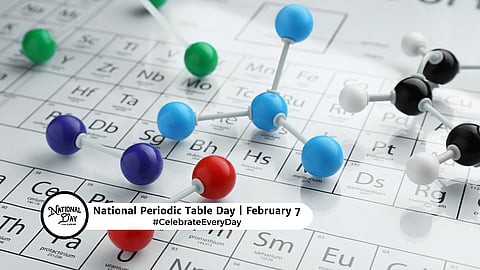
NATIONAL PERIODIC TABLE DAY
On February 7th, National Periodic Table Day recognizes the publication of the first table of elements. Let's take a at how the periodic table has changed through the years.
#PeriodicTableDay
The periodic table has a long history. Ancient man only knew of a few elements. By the 1st century A.D., mankind knew about the elements of gold, silver, copper, iron, lead, tin, mercury, sulfur, and carbon. Over time, arsenic, antimony, phosphorus, and zinc were added to our discoveries. By 1809, there were 47 discovered elements.
Johann Döbereiner made one of the earliest attempts to organize the list of elements in 1817. He placed each element into one group of three triads--Alkali Metal Triad, Alkaline Earth Triad, and Halogen Triad. Döbereiner noticed that certain elements could be grouped in threes where the middle element had an atomic weight approximately equal to the average of the other two. However, Döbereiner's element table was eventually replaced because not all elements could be placed in a triad.
John Newlands
On February 7, 1863, English chemist John Newlands published one of the first table of elements. Newlands divided the known 56 elements into 11 groups based on the "Law of Octaves." His table suggested that anyone element will have similar properties to elements eight places before and behind it on the table.
Arranging the elements according to increasing atomic weight, Newlands was one of the first scientists to detect a pattern to the properties of elements. As a result, his table left room for new discoveries. It even predicted future discoveries would complete the table. In fact, Newlands correctly predicted the discovery of Germanium.
Future Discoveries
While parts of Newlands' periodic table contained flaws, so did other later proposed tables. In 1869, chemist Dimitri Mendeleev published a paper after developing his own periodic table. Mendeleev's table also arranged the elements based on atomic mass. By this time, science had only identified 60 of the over 100 elements we know today.
As on previous tables, inaccuracies were attributed to some of those elements. While Mendeleev corrected some of these inaccuracies, he didn't correct them all. His assumptions about some elements caused incorrect placement on his periodic table version. Like Newlands, Mendeleev also predicted discoveries, and he correctly predicted the properties of five elements and their compounds.
The discoveries throughout Scot William Ramsay's career from 1892 to 1910, along with John William Strutt, Morris Travers, and Frederick Soddy led to the identification of the noble gasses. In 1904, the Nobel Prize was awarded to Ramsay for discovering five elements.
Henry Moseley
Henry Moseley, an experimental physicist, contributed to the development of the modern periodic table we know today. In 1913, Moseley discovered that each element has a specific number of protons. As a result, four new chemical elements were later found, though not during his lifetime.
Since the early 20th century, the periodic table remains largely unchanged. However, the 21st century is still young. Some researchers suggest new approaches to the periodic table while maintaining its integrity as one of the most valuable tools in the science of chemistry. The current table tallies a total of 118 elements.
HOW TO OBSERVE NATIONAL PERIODIC TABLE DAY
Test your knowledge of the periodic table. Celebrate with Periodic Table trivia or challenging each other to name the elements. Take it a step further and name the number of protons in each element.
Visit this page for more information: Periodic Table of Chemical Elements. Scroll down and discover activities and resources for students and educators from elementary school to post-doc, including a gallery of periodic tables.
Use #PeriodicTableDay to post on social media.
NATIONAL PERIODIC TABLE DAY HISTORY
On February 7, 2016, the first National Periodic Table Day was founded. The day serves to promote the challenges overcome to develop the modern periodic table. Mr. David T. Steineker, author, inventor, and chemistry teacher at Jefferson County Public Schools in Kentucky is inspired by those challenges. He took the initiative to celebrate National Periodic Table Day based upon John Newlands' first table of the elements published on February 7, 1863.
Periodic Table FAQ
Q. How many elements are on the periodic table?
A. The periodic table includes 118 elements.
Q. What's the heaviest element on the periodic table?
A. The heaviest element by atomic weight is oganesson (Og), first synthesized in 2002. It is also one of two elements that have the greatest density. The other is iridium (Ir)
Q. What is the lightest element on the periodic table?
A. Hydrogen (H) is the lightest element on the periodic table.