
PLUTO DAY
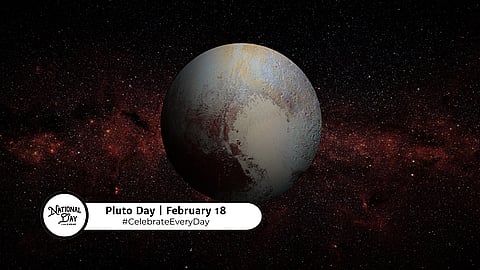
PLUTO DAY
Every year on February 18, we celebrate the date the dwarf planet Pluto was discovered. Join us as we travel through space to discuss who discovered this mysterious planet and why it's been a discussion of classification controversy.
#Pluto
Percival Lowell was the astronomer who first predicted the existence of a "Planet X" hidden beyond Neptune. Lowell dedicated much of his life to searching for this mysterious ninth planet; unfortunately, he passed away in 1916 without ever finding it. It would take another 14 years of searching before Lowell’s "hunch" was finally proven correct.
On February 18, 1930, Clyde Tombaugh—a young astronomer working at the Lowell Observatory—finally spotted the elusive object. On March 19, 1930, the observatory officially announced to the world that the ninth planet had been found. While several names were considered, the name Pluto (the Roman god of the underworld) was ultimately chosen. It was a fitting tribute, as the first two letters, P and L, serve as a permanent nod to the initials of Percival Lowell.
Pluto the Dwarf Planet
On August 24, 2006, the International Astronomical Union (IAU) reclassified Pluto as a dwarf planet, removing it from the list of planets in the solar system. The IAU established three specific criteria that a celestial body must meet to be considered a full-sized planet. That criteria is:
It must orbit the Sun.
It must have sufficient mass to assume a nearly round shape (hydrostatic equilibrium).
It must "clear the neighborhood" around its orbit.
According to the IAU, Pluto meets the first two criteria but fails the third. Pluto shares its orbital path with a vast collection of debris in the Kuiper Belt. Modern technology has allowed astronomers to find other bodies (like Eris) that are comparable in size. Today, the IAU officially recognizes five dwarf planets: Ceres, Pluto, Eris, Haumea, and Makemake.
Despite these facts, scientists and the general public, have had a hard time accepting the idea that Pluto is no longer a planet. Many people remember the mnemonic, “My Very Educated Mother Just Served Us Nine Pizzas.” The first letter in each world helped them to remember the order of the planets. The “P” in Pizza, referred to Pluto. The mnemonic was changed to “My Very Educated Mother Just Served Us Noodles.”
Just because it is no longer a planet, you can still learn interesting facts about Pluto:
Since its discovery, Pluto has not made a complete orbit around the sun.
It has five known moons.
Pluto’s extremely thin atmosphere consists mostly of nitrogen.
One day on Pluto equals 6.4 days on Earth.
It has ice mountains that are taller than the Rockies.
HOW TO OBSERVE #PlutoDay
Planetariums, observatories, and science centers often hold special events on February 18. Here is how you can participate:
Set up a telescope! Even though Pluto is hard to spot, it's a great excuse to stargaze.
Learn more about the differences between planets and dwarf planets.
Do you think Pluto deserves its "Major Planet" status back? If so, write a post or start a discussion.
Check out documentaries like The Year of Pluto, Mission Pluto, or Chasing Pluto.
No matter where you stand on the "planet" debate, share your love for this icy world on social media using #PlutoDay.
PLUTO DAY HISTORY
Pluto Day commemorates the anniversary of its discovery each year on February 18th, 1930.