SCHWENKFELDER THANKSGIVING
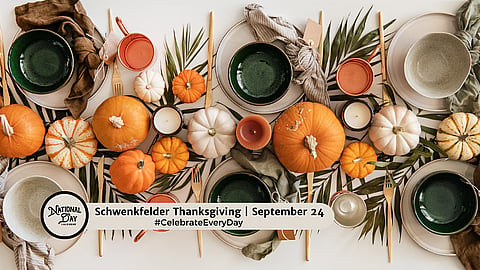
SCHWENKFELDER THANKSGIVING | SEPTEMBER 24
On September 24 Schwenkfelder Thanksgiving expresses thanks in a way that dates back to 1734.
#SchwenkfelderThanksgiving
The Schwenkfelders are the descendants of a small Protestant sect that sprang up in Germany around the time of the eformation. They were followers of Caspar Schwenckfeld, a theologian. He and his followers separated from Protestant circles and formed the brotherhoods that still survive as the Schwenkfelder Church. Most Schwenkfelders now live in Pennsylvania Dutch country.
CELEBRATE SCHWENKFELDER THANKSGIVING
Cook up a Thanksgiving spread. Celebrate with your garden bounty and the fruits of your labors. Create new traditions to carry forward generation after generation. Give thanks for the blessings and rewards in your life. Use #SchwenkfelderThanksgiving to post on social media.
SCHWENKFELDER THANKSGIVING HISTORY
In 1733, a handful of Schwenkfeldian followers arrived in Philadelphia. A second group came from Germany on September 22, 1734. They swore their allegiance to the British king; then they spent September 24 expressing their thankfulness to God for having delivered them from persecution.
This Thanksgiving event is the oldest continuously observed Thanksgiving event in the United States. The traditional Thanksgiving celebrated at the end of November didn't get its start until the end of the Civil War.
While the Pilgrims held their first Thanksgiving feast in 1621, the observance didn't continue uninterrupted. Days of fasting and thanksgiving on an annual or occasional basis became common practice in other New England settlements. George Washington even proclaimed the Nation's first Thanksgiving in 1789. And while his successors followed suit, designating days of thanks, they weren't consistent.
It wasn't until 1863 that Abraham Lincoln proclaimed a national Thanksgiving for the last Thursday in November. Annually, the country gave thanks on that day until 1939. That year, Franklin D. Roosevelt moved the observance to the fourth Thursday, and that's where it stayed.