
WORLD MIGRATORY BIRD DAY
WORLD MIGRATORY BIRD DAY
World Migratory Bird Day is observed twice a year during the second Saturday in May and again on the second Saturday in October. The goal is to raise awareness of issues affecting migratory birds and to inspire action around the world to take measures for their conservation.
#BirdDay
The journey of a migrating bird is one of nature's most incredible feats of endurance and navigation. Fueled by instinct, these elite athletes undertake epic voyages, with their daily travel distances ranging from a modest 15 miles to an astounding 600 miles or more. The exact distance depends on the length of their total journey, the urgency of the season, and the challenging conditions they face along the route, from battling headwinds to finding crucial places to rest and refuel.
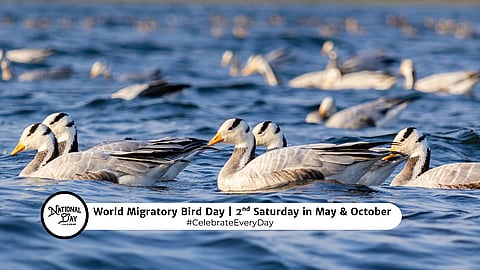
While most birds cruise at altitudes below 2,000 feet, some push the limits of what seems possible. The bar-headed goose holds the astonishing record, recorded flying at up to 30,000 feet—an altitude where commercial jets cruise—as they cross the mighty Himalayas. They can achieve this thanks to highly efficient lungs and specialized hemoglobin that allows them to extract oxygen from the thin, frigid air.
“If I had to choose, I would rather have birds than airplanes.” – Charles Lindbergh
“I feel I am strange to all but the birds of America.” – John James Audubon
The timing of a bird flight is a strategic event. Large birds like hawks, swallows, and waterfowl are primarily daytime (diurnal) migrants. These types of birds use the sun and geographical landmarks to navigate and taking advantage of thermal updrafts to conserve energy. In contrast, many smaller songbirds become masters of the night. Migrating under the cover of darkness allows them to avoid predators like hawks. It also provides cooler, calmer air for flight, and these amazing navigators use the stars and the Earth's magnetic field to guide their way. Whether by day or by night, these bird journeys are a breathtaking testament to the resilience and instinct of the animal kingdom.
HOW TO OBSERVE #BirdDay
Throughout North America, events, programs and activities are happening at protected areas, parks, museums, schools, zoos, and more, including many national wildlife refuges. As many as 700 events and programs are hosted annually to introduce the public to migratory birds and ways to conserve them. Start a journal of birds you can see migrating through your neighborhood or download a bird watching app to your smartphone and take it on a visual search for birds in your neighborhood. Use #MigratoryBirdDay or #BirdDay to share on social media.
WORLD MIGRATORY BIRD DAY HISTORY
Since 1993, the Environment for the Americas coordinates the bi-yearly observances of World Migratory Bird Day. Dozens of organizations sponsor events including the U.S. Fish & Wildlife Service.
DATES
10 May 2025
9 May 2026
8 May 2027
13 May 2028
12 May 2029
11 October 2025
14 October 2026
9 October 2027
11 October 2028
13 October 2029